
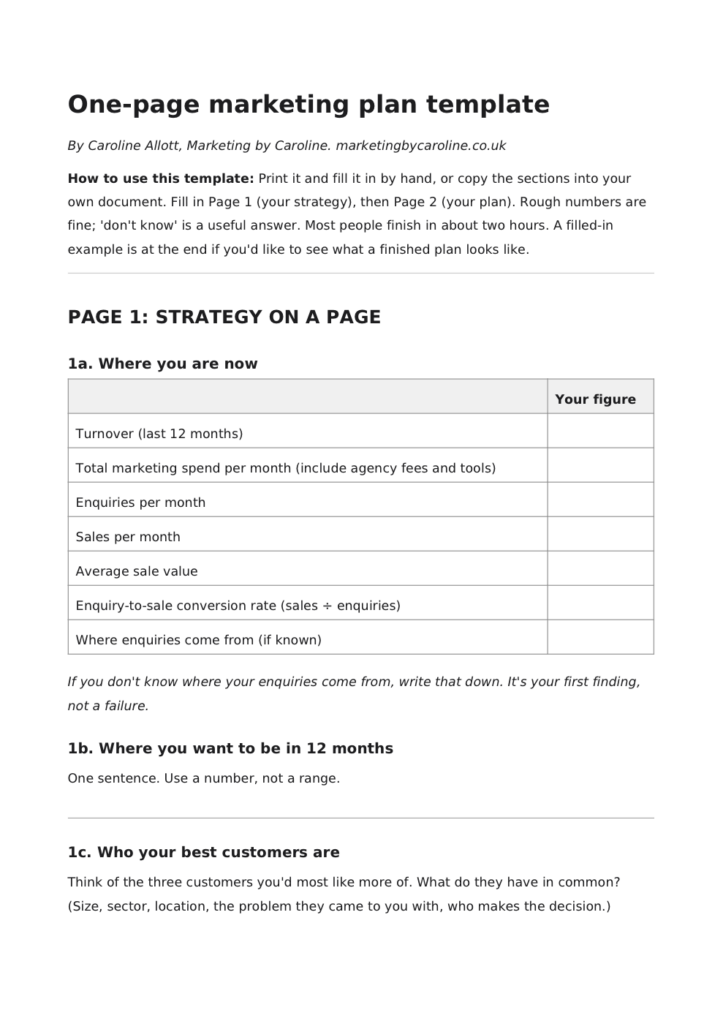
This free marketing plan template is one page for your strategy and one page for your plan, built around the numbers a managing director actually needs: what you’ll spend, how many enquiries and sales it should bring in, and how you’ll know what’s working and what isn’t. Most people fill it in in about two hours.
Typically somewhere between £1m and £20m turnover. You might be the managing director who signs off the spend, or the in-house marketer who has been asked to 'write the plan' by Friday.
It assumes you already have customers, some marketing running and a rough idea of what you spend.
If you suspect part of that budget is being wasted, this template is designed to show you where.
There are five short sections across two pages.
Where you are now (turnover, marketing spend, enquiries and sales per month), where you want to be in 12 months, who your best customers are, why they choose you over competitors, and the one or two priorities for the year.
A revenue goal, then a working-backwards table. You enter your average sale value and how many enquiries turn into sales, and it shows how many sales and enquiries you need each month.
Rows for Google Ads, Meta and other social ads, SEO and website, email, events and PR, agency or freelance fees, tools and anything else. Each row has a monthly budget, expected enquiries, cost per enquiry and an owner. At the bottom you work out your overall cost per sale.
A checklist: is conversion tracking set up and tested, are enquiries recorded by source, who reports each month, and what is the one number on that report.
Keep, change or stop for each channel, plus a box for what you learned.
For example: you need more enquiries than your budget can realistically buy at the cost per enquiry you’ve entered; you have a large paid ads budget but haven’t ticked that tracking is working; or most of your budget sits in a single channel.
None of these is automatically wrong. They are the questions I’d ask if you showed me the plan.
Spend, enquiries and sales, even if they’re rough. If you don’t know how many enquiries came from Google Ads, that is your first finding, not a failure. Write ‘don’t know’ and move on.
Pick a single figure for new sales over the next 12 months. Divide by your average sale to get the number of sales, then by your conversion rate to get the number of enquiries. The worked example below shows how.
Include the bits people forget, such as agency fees and software subscriptions. They are part of what each enquiry costs you, whether or not they appear on the ads invoice.
A channel with no owner is a channel nobody is checking. One name per row, even if that name is yours.
If you can’t say how you’ll know whether a line is working, either fix the measurement first or treat that spend as a test with an end date.
Four dates, an hour each. It’s the cheapest step in the whole plan and the one most often skipped.
This is a made-up example to show the maths. It isn't a client and the figures aren't client data.
Now put a cost on those 60 enquiries from Google Ads:
That works out at £200 per sale.
Same target, or £480 per sale.
Same target, same business, more than double the budget. That’s why the cost per enquiry matters far more than the number of clicks in your report.
Many plans do this the other way round: they start with a budget and hope the sales follow. Hope is a lovely thing, but it’s hard to put in a spreadsheet.
Who you're for, why they'd choose you and what you'll focus on.
What you'll do, when, with what budget, and how you'll measure it.
You need both. But the strategy part should fit on one page. If it doesn’t, it probably isn’t a strategy yet; it’s a list of things you’d like to do.
That’s why the first page of this template is a marketing strategy template, with the plan underneath. Every line of budget on page two should trace back to a priority on page one. If your channels have grown up separately over the years, here’s how to turn a pile of disconnected marketing into a joined-up plan.
These usually happen one sensible decision at a time, so don’t be hard on yourself if you recognise a few.
‘Post on LinkedIn three times a week’ is a task. The plan needs to say what that should produce in enquiries or sales.
It’s tempting because it’s what you did last year. That’s a reason, but not a good one.
If your Google Ads report looks wonderful but enquiries are flat, check the conversion tracking before anything else. Here’s why conversion tracking is broken in most accounts I audit.
‘Between £200,000 and £600,000’ is a shrug with a number attached to it. Pick one figure. You can be wrong and adjust at the quarterly review.
A plan you don’t revisit is a wish list with formatting.
There’s no single right answer, and I’d be wary of anyone who gives you one without asking questions. It depends on your margins, how fast you want to grow and how established you are.
The working-backwards maths gives you a starting point: the budget your target needs at your real cost per enquiry. For a fuller answer, read how much a £5m business should spend on marketing. If a large share of that budget goes on Google Ads, these nine checks to run on your Google Ads account are worth an hour of your time.
Some businesses fill this in and realise the real problem: nobody owns the whole picture. The ads agency looks after the ads, someone else does the website, the sales team has its own view, and no one joins it up.
That’s where a Fractional CMO (Chief Marketing Officer) comes in. It means part-time marketing help at senior level: one person who owns the strategy and budget, without the cost of a full-time hire. You can read what happens in the first 90 days with a Fractional CMO.
Return on ad spend (ROAS) means the sales you get back for every pound spent on ads. For Royal Armouries, where I’ve worked with the team since 2023, the focus was fixing tracking and campaigns. Read how Rucklidge Law reached 30–50 qualified leads a month and the Royal Armouries Google Ads and Meta results.
If you’re not ready for that, a marketing audit is a useful middle step. It checks what’s working and what isn’t before you rewrite the plan. You’ll find details of my marketing strategy, planning and Fractional CMO services on my services page.
And you’re very welcome to use the template and never get in touch. That’s what it’s for.
Where you are now, where you want to be, who you’re for and why they choose you, a sales target worked back to enquiries, a budget by channel with owners, how you’ll measure it, and review dates. Anything else is optional.
No. The template is a PDF that downloads straight away, with no email or login. Print it, or fill it in alongside your own numbers.
For most established businesses, two pages: one for strategy, one for the plan. You can attach detail behind it, but if the core doesn’t fit on two pages, it’s hard to act on.
Divide your sales target by your average sale to get the number of sales. Divide that by your conversion rate from enquiry to sale to get the number of enquiries. Multiply by your cost per enquiry to get the budget.
Start from what each channel really costs per enquiry, if you can measure it, rather than last year’s split. Put more where enquiries are cheapest and quality is good, and treat anything you can’t measure as a test with an end date.
I’d suggest a short review every quarter, plus a monthly look at the one number on your report. Quarterly gives most channels enough time to show a pattern without letting a poor one run all year.
Check that conversion tracking is set up and tested, record where every enquiry comes from, and compare cost per enquiry and cost per sale against the figures in your plan.
When nobody owns the whole picture, when you can’t get reliable numbers out of your tracking, or when you’ve written plans before and they haven’t changed anything.
Fill in the template, then book a free consultation. Talk me through your plan and I’ll tell you plainly what I’d keep, what I’d change and what I’d stop. If you’d rather email first, I’m at hello@marketingbycaroline.co.uk.
If you’d like more reading first, there are more articles on marketing strategy in my Insights section.